The Modern Prince by Carnes Lord
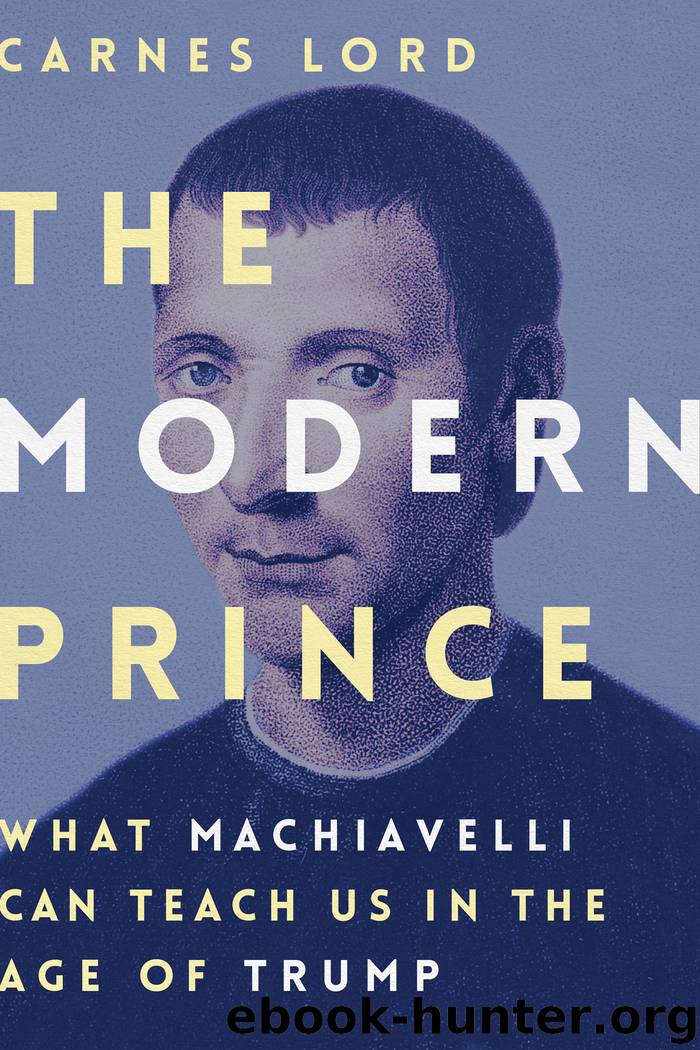
Author:Carnes Lord
Language: eng
Format: epub
Publisher: Encounter Books
Published: 2018-10-09T16:00:00+00:00
XV
EDUCATION AND CULTURE
Opinion polls in the United States show that education is regularly seen by the general public as a political issue of the highest priority, and politicians—particularly state legislators and governors, but also congressmen and presidents—routinely pay at least lip service to its importance. The reason, of course, is that the quality of public education has immediate and visible effects on people’s lives and on their futures. In our egalitarian and diverse society, it is a key avenue of cultural assimilation and social mobility. It is all the more remarkable, then, that contemporary political science seems to pay so little attention to it. Much ink is certainly spilled on the subject by education professionals and by journalists, but it remains very much at the margins of political analysis.1
In the United States, of course, education is largely a state and local responsibility. A federal Department of Education has existed only since the late 1970s, and its powers do not begin to approach those of education ministries in other advanced democracies. Yet the phenomenon we are considering has much deeper roots. Ultimately, it reflects a fundamental shift at the origins of modern liberalism from education to institutions as the central mechanism of regime management.
In traditional political science, education loomed large as a topic of interest. It is the central theme in the greatest document of that tradition, Plato’s Republic, and Aristotle deals with it extensively in his Politics. Both writers were deeply concerned with developments in the culture of their day that they felt were negatively affecting the education and outlook of potential political leaders and the political class generally. The spurious instruction offered by itinerant sophists and rhetoricians helped fuel the political ambitions of the young but lacked all moral compass. Plato’s “philosopher-kings” provided one kind of response to this challenge. Another, more practical and palatable, was Aristotle’s reform of traditional aristocratic education—a forerunner, it can be argued, of the idea of “liberal education” as we know it today. Still another was the reform of rhetorical instruction associated with the names of Isocrates and Cicero, an important (if now largely forgotten) source of modern humanistic education.2
In The Prince, Machiavelli announces a fundamental break with this entire mode of thinking. Claiming that it is “more fitting to go directly to the effectual truth of the thing than to the imagination of it,” he tells us, “And many have imagined republics and principalities that have never been seen or known to exist in truth; for it is so far from how one lives to how one should live that he who lets go of what is done for what should be done learns his ruin rather than his preservation. For a man who wants to make a profession of good in all regards must come to ruin among so many who are not good. Hence it is necessary to a prince, if he wants to maintain himself, to learn to be able not to be good, and to use this and not use it according to necessity.
Download
This site does not store any files on its server. We only index and link to content provided by other sites. Please contact the content providers to delete copyright contents if any and email us, we'll remove relevant links or contents immediately.
| Anthropology | Archaeology |
| Philosophy | Politics & Government |
| Social Sciences | Sociology |
| Women's Studies |
The Secret History by Donna Tartt(19097)
The Social Justice Warrior Handbook by Lisa De Pasquale(12193)
Thirteen Reasons Why by Jay Asher(8915)
This Is How You Lose Her by Junot Diaz(6891)
Weapons of Math Destruction by Cathy O'Neil(6283)
Zero to One by Peter Thiel(5805)
Beartown by Fredrik Backman(5761)
The Myth of the Strong Leader by Archie Brown(5511)
The Fire Next Time by James Baldwin(5451)
How Democracies Die by Steven Levitsky & Daniel Ziblatt(5221)
Promise Me, Dad by Joe Biden(5155)
Stone's Rules by Roger Stone(5089)
A Higher Loyalty: Truth, Lies, and Leadership by James Comey(4965)
100 Deadly Skills by Clint Emerson(4929)
Rise and Kill First by Ronen Bergman(4792)
Secrecy World by Jake Bernstein(4755)
The David Icke Guide to the Global Conspiracy (and how to end it) by David Icke(4721)
The Farm by Tom Rob Smith(4516)
The Doomsday Machine by Daniel Ellsberg(4492)
